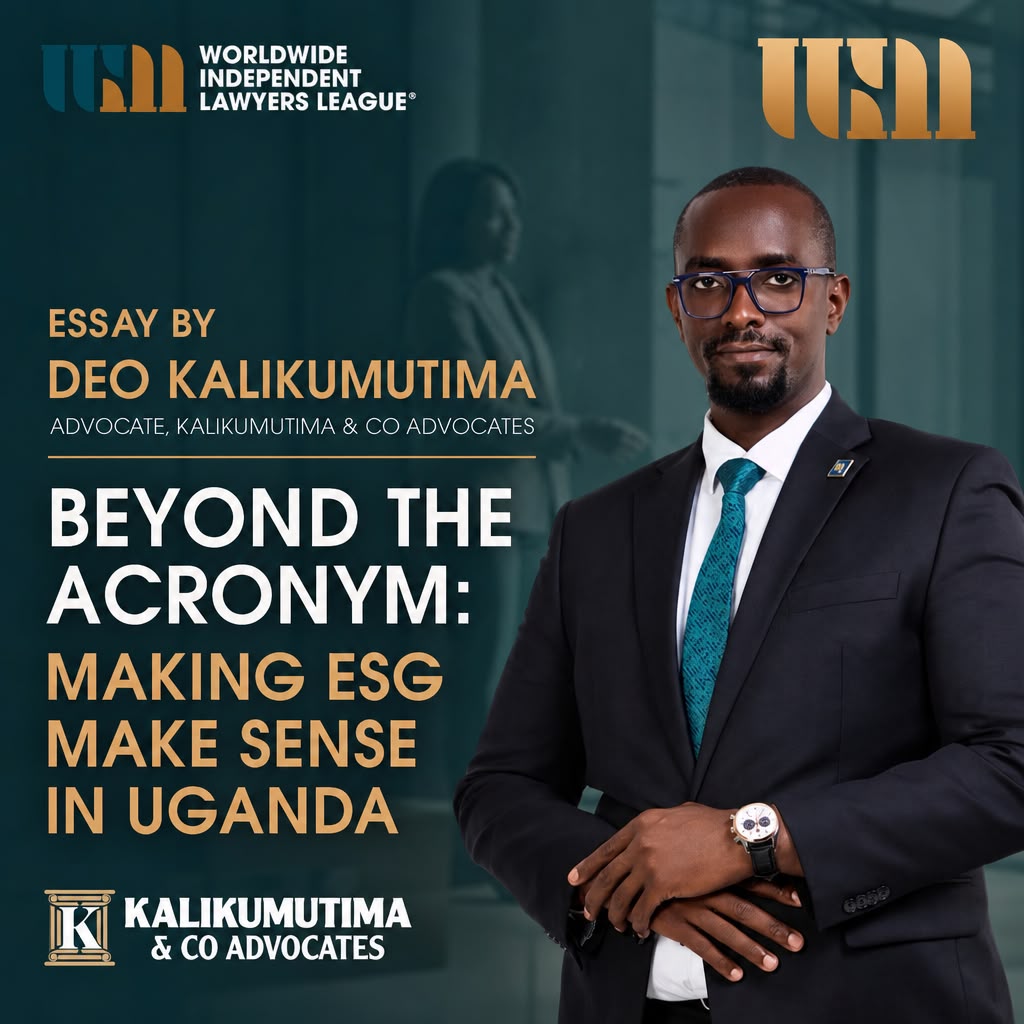
On 25 September 2026, Uganda’s first National ESG Conference and Expo convened at Mestil Hotel under the theme “Driving Transformation through ESG: From Commitment to Action.” Kalikumutima & Co. Advocates was privileged to serve as a strategic partner in that national conversation. One truth emerged clearly: Uganda does not suffer from a shortage of ESG language. Our challenge is turning that language into choices people can understand, own, practise and measure.
ESG has acquired an unfortunate reputation for being complicated, foreign and expensive. Yet its Environmental, Social and Governance principles are remarkably familiar. Long before sustainability reports, green taxonomies and disclosure standards, Ugandans understood stewardship: protect the land that sustains you, treat people fairly, account for what is entrusted to you and preserve value for those coming after you.
Genesis 2:15 captures this beautifully: humanity was placed in the Garden “to work it and take care of it.” Create value, but preserve what creates value. ESG may be a modern acronym; stewardship certainly is not. Perhaps we did not import the principle after all; we simply gave an ancient responsibility a corporate wardrobe.
The E asks how we treat the environment and how environmental change affects us. A farmer protecting soil fertility, a hotel reducing water consumption, a manufacturer responsibly managing waste, or a family refusing to build in a wetland is already engaging with E. Environmental responsibility is not simply about planting trees. It is about conserving resources, managing waste, protecting biodiversity and preparing for climate risks that threaten tomorrow’s prosperity.
The S puts people at the centre. It appears when a construction supervisor insists on protective equipment, an employer provides a safe and dignified workplace, or a developer genuinely listens to affected communities. It means fair employment, inclusion, respect for human rights and creating opportunities for local businesses and young people. Social responsibility is not corporate kindness; trust, dignity and opportunity are productive assets.
The G is where integrity becomes decisive. Governance asks who decides, on what information, under which controls, and who answers when something goes wrong. Proper records, transparent procurement, disclosed conflicts, effective boards, whistleblowing channels and responsible leadership are ESG in practice. Integrity is not decoration around decision-making; it is the architecture that makes responsible decision-making possible.
This is why ESG cannot remain comfortably collective. Saying “the company is responsible” means little if everybody assumes somebody else will act. If waste is discharged into a drainage channel, who monitored it? Who received the report? Who had authority to intervene? Who failed to act? Accountability becomes meaningful when responsibility can be traced from the institution, to the decision, to the individual.
ESG is also more than compliance. Compliance asks, “What does the rule require?” ESG asks, “How do we build responsibility into the way we operate?” A bank should consider environmental and social risk before financing a project, not after it fails. A developer should engage communities before construction, manage safeguards during implementation, and measure impact afterwards. ESG should therefore travel through procurement, recruitment, lending, production, logistics and customer service.
Frameworks remain important because they establish standards and enable measurement. But frameworks are scaffolding, not the building; the building is what people actually do. We may recite all seventeen Sustainable Development Goals, but what use is perfect recitation if an employee, entrepreneur or farmer cannot translate them into Tuesday-morning behaviour? Sometimes sustainability sounds as though one needs three consultants, two conferences and a 200-page report before switching off an unnecessary light.
Uganda therefore needs an ESG culture that works for the multinational and the roadside enterprise alike. An SME can begin with simple questions: How much energy and water are we using? Where does our waste go? Are our employees safe? Are grievances addressed? Are our records proper? Are conflicts disclosed? What impact are we having on our community?
The formula is simple: start small, measure, improve and report. Measurement turns intention into evidence; improvement turns evidence into performance. ESG becomes powerful when it stops being an annual ceremony and becomes a continuous management discipline.
Uganda’s opportunity is to domesticate ESG without diluting it: translating global standards through values we already understand; stewardship, community, responsibility, integrity and intergenerational preservation. ESG must move from boardroom strategy to operational habit, from collective promises to individual accountability, and from impressive reporting to integrity in ordinary decisions.
The ultimate test is simple: if the sustainability report disappeared tomorrow, would responsible behaviour remain? If the answer is yes, ESG has ceased being an acronym and become culture.
Rotarian Kalikumutima Deo
Chief Executive Partner
Kalikumutima & Co. Advocates